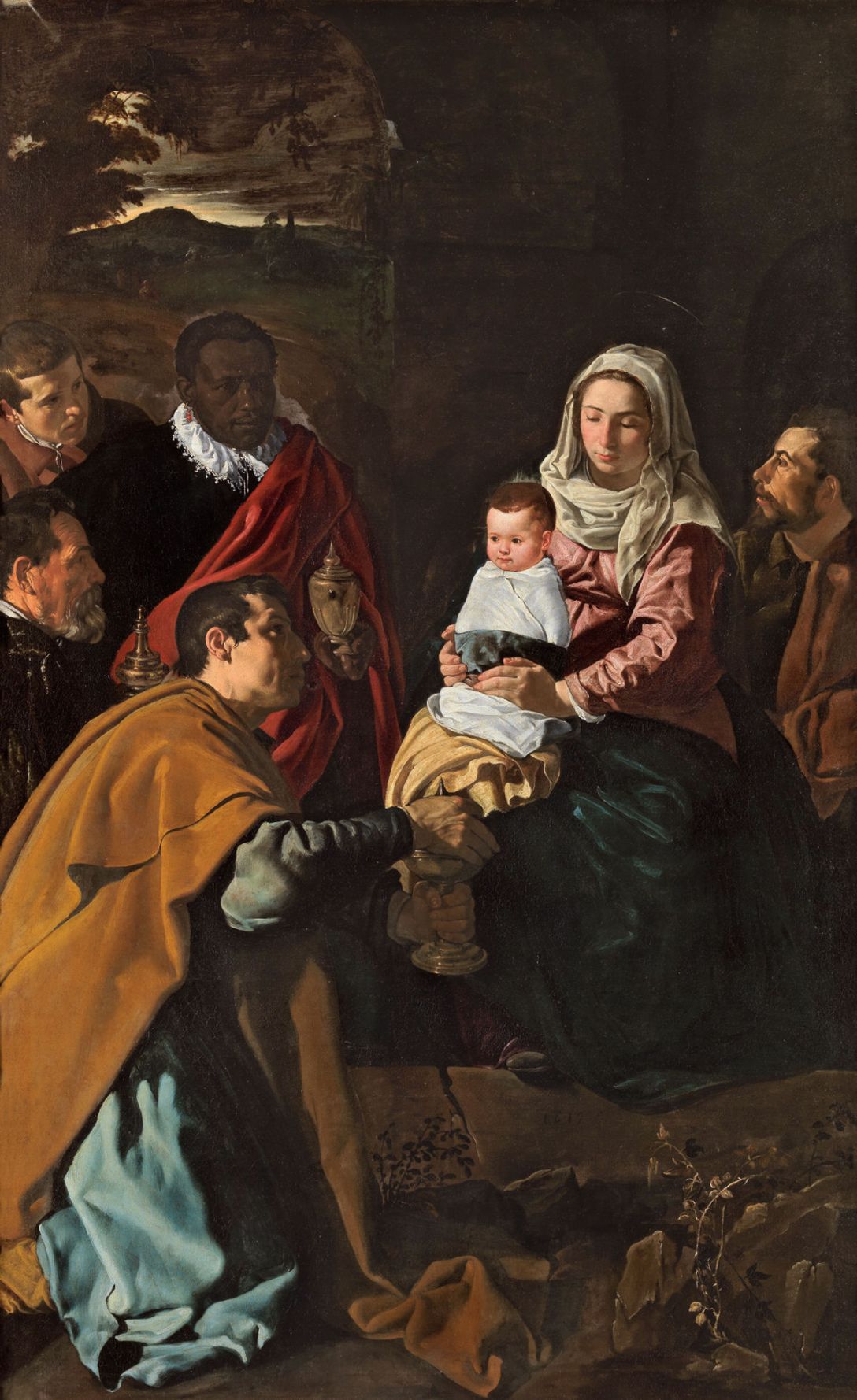
There is a lot of advice out there geared toward writers, but I find it more helpful to think of the process the way a Renaissance painter might approach a new painting.
First, a theme, the more specific the better. “Motherly love” is nice but vague. “The wistful feelings of a mother gazing at her child knowing that child will grow beyond her reach and will suffer in ways she cannot prevent” is more specific and, by the narrowness of its scope, makes it easier for us and our audience to gauge our success. Limitations are freeing; by defining a narrow scope of theme, we automatically rule out a vast amount of material that doesn’t belong in our composition, and now we can focus on the few things that really matter. In this case, the expression on the mother’s face, the tilt of her head, the set of her mouth, and especially her eyes.
Second, a “plot”, the vehicle for conveying my theme. Because I am a Renaissance painter, the most obvious plot point to express my theme is Mary Magdalene cradling baby Jesus. I am likely working for wealthy patrons. It is customary for a painter to flatter their patrons, so perhaps I will include the Magi in my painting, with my patrons’ faces representing them. And because it is the Renaissance, I am (or feel obliged to appear) fiercely nationalistic, so my background will be the local countryside. These are the plot points: Mother and Child, Adoration of the Magi, and Landscape. To be most effective, each plot point must serve my theme. I may choose to hint through their rich clothing and worldly expressions that the Magi represent the vast, powerful, often uncaring, and often manipulative world outside the embrace of the Mother, the world in which the Child must be set free to suffer beyond her ability to help. The landscape may be appropriately melancholy to reflect this world of suffering.
Now we begin. It may be tempting to start with the most important parts: the expression on the mother’s face, the tilt of her head, the set of her mouth, and especially her eyes. But what if we paint Mary’s face and then discover later that we’ve put it in the wrong place, spoiling the balance and harmony of the overall composition? Do we undertake the labor to paint it over or start over with a fresh canvas, losing all the work we’ve done?
Better to start loose and sketchy. Most painters will do an underdrawing on the canvas to ensure that each shape and figure is in the correct place and proportion. Keeping the composition loose at this stage makes it relatively easy to alter, add, and subtract as we begin to see what we have thus far only imagined. The first draft of a novel is like an underdrawing. If we write too tightly, or get bogged down trying to make it perfect, we can wind up making more work for ourselves later when we inevitably need to move scenes, write in a new character, change a setting, and so on.
At this stage, it is most important to write what you know, get it out on paper so you can look at it, and keep it loose enough to make it easy to edit later. For many writers, this means blocking out action and dialogue sequences. Detailed descriptions of environments, characters, and emotions may be more difficult to imagine at this stage – and that’s okay.
Going back to our painting, once the underdrawing is completed to our satisfaction, now we can start painting. Often this begins with an underpainting, blocking out color values and testing the theories of the underdrawing. This phase can help us understand and direct the mood of the painting, even before any of the detail work begins.
Filling in those gaps among the action and dialogue can help us test how well those scenes really work in the context of our theme. If the action we’ve written is sprightly and the dialogue is all sparkling banter, but the descriptions of the setting are melancholy, we may need to reconsider one or the other. On the other hand, if one of our themes is “courageous optimism in the face of sorrow”, we may be right on track. Working in phases this way allows us to test and validate our essential assumptions about the work.
In the later stages of the painting, we overpaint with our details, working finer and finer until we finish with subtle shadows and highlights – the details that make Mother Mary’s gaze convey that sense of wistfulness, longing, and helpless love. In the context of a novel, this means in later drafts we test and polish each sentence for maximum utility and maximum service to the theme. There is no point trying to do this work earlier – making Chapter One absolutely perfect when you still haven’t written the final chapter can prove to be wasted effort. What if you finish the first draft only to discover that Chapter One doesn’t belong at all? Wait until you are sure of the composition and have worked out the big problems before you pull out your fine brushes and start adding highlights.
Many writers place too strong an emphasis on their first draft; they read their initial effort and feel that it isn’t good enough. I believe that comparing your first draft to a final draft is like comparing an underdrawing to a finished oil painting: not only is the comparison unfair, but it also betrays an immature understanding of the craft. A first draft is its own unique thing, a framework on which the rest of the novel is hung, and like the underdrawing, is never visible to the audience. If you have done your work well, your audience will be captivated by the tenderness in Mary’s eyes and never know – or care – how many times you erased lines from your underdrawing to get it just right.
Featured image: Diego Velázquez’s 1619 Baroque painting, “Adoration of the Magi.”

 Chronicler's Note: